Can the Lok Sabha Speaker Be Removed During Tenure?
Context
A resolution seeking the removal of the Speaker of the Lok Sabha was recently mentioned during the Budget Session of Parliament, highlighting constitutional provisions regarding the removal procedure and powers of the Speaker.
SPEAKER OF LOK SABHA
Definition
The Speaker of the Lok Sabha is the presiding officer of the Lower House of Parliament who regulates debates, maintains order, and ensures that the business of the House runs according to the Constitution, Rules of Procedure, and Parliamentary conventions.
CONSTITUTIONAL PROVISIONS
| Provision | Details |
| Article 93 | Lok Sabha shall choose two members as Speaker and Deputy Speaker |
| Article 94 | Vacation, resignation, and removal of Speaker |
| Article 95 | Powers of Deputy Speaker or other members when Speaker is absent |
| Article 97 | Salaries and allowances of Speaker |
ELECTION OF THE SPEAKER
Constitutional Basis
Article 93 of the Constitution
Procedure
- The Speaker is elected by members of the Lok Sabha.
- Election usually happens soon after the first sitting of a newly constituted Lok Sabha.
- The President fixes the date for election.
Voting Method
- Conducted through a simple majority of members present and voting.
Convention
- Usually from the ruling party or coalition.
- After election, the Speaker is expected to act impartially.
TENURE OF THE SPEAKER
The Speaker remains in office:
- From the date of election
- Until just before the first meeting of the next Lok Sabha
Important feature:
The Speaker continues even after Lok Sabha dissolution until a new Speaker is elected.
This ensures continuity of parliamentary functioning.
REMOVAL OF THE SPEAKER
Constitutional Provision
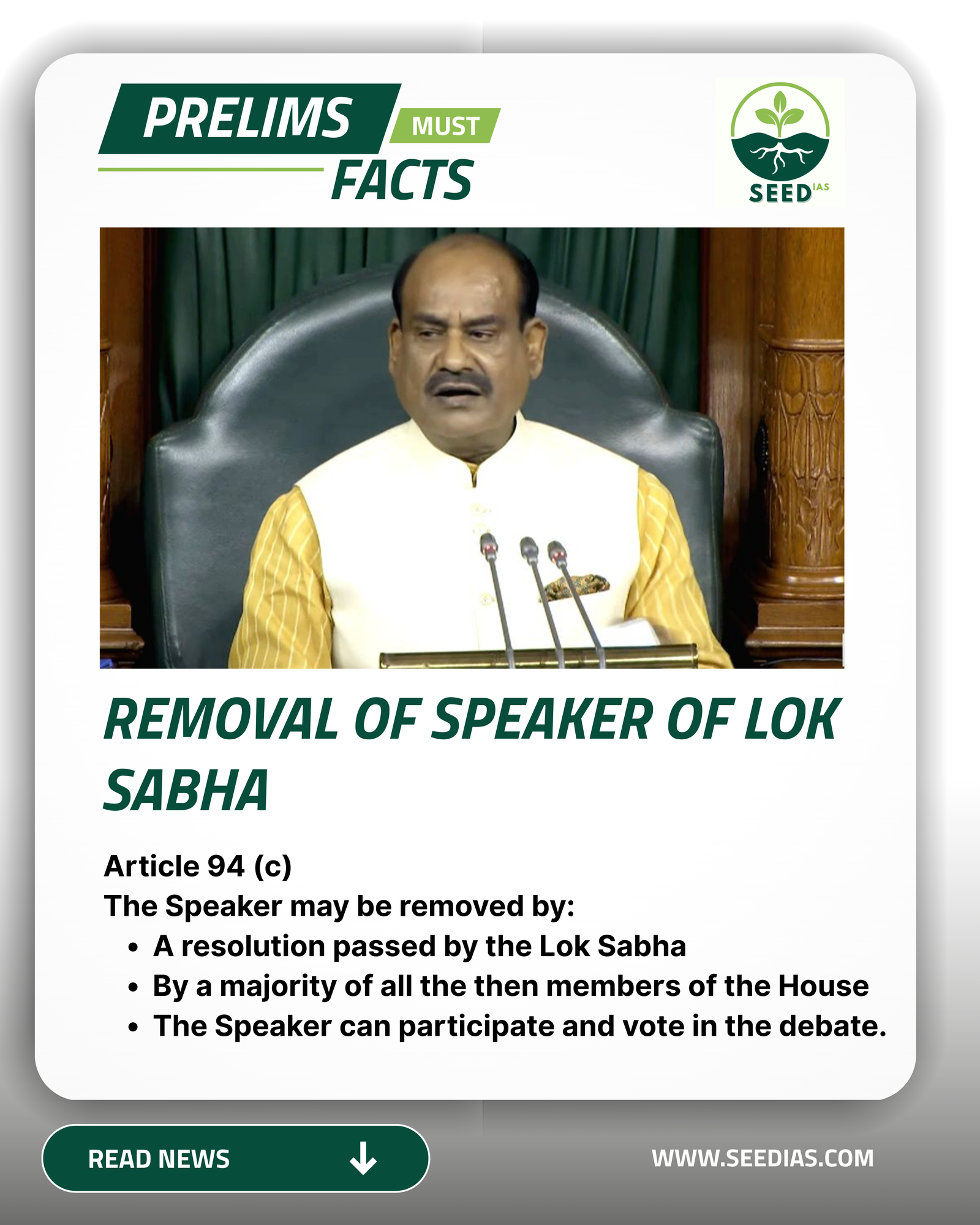
Article 94 (c)
The Speaker may be removed by:
- A resolution passed by the Lok Sabha
- By a majority of all the then members of the House
Procedure
- At least 14 days’ notice must be given.
- A resolution for removal is moved in Lok Sabha.
- During the debate on the motion:
- Speaker cannot preside over the sitting.
- The Deputy Speaker presides during the discussion.
- If the motion passes with the required majority, the Speaker is removed.
KEY FEATURES OF REMOVAL
- Only Lok Sabha can remove its Speaker.
- Rajya Sabha has no role.
- The Speaker can participate and vote in the debate.
POWERS AND FUNCTIONS OF THE SPEAKER
1. Presiding Powers
The Speaker:
- Presides over Lok Sabha sittings
- Maintains order and discipline
- Decides who speaks and for how long
2. Interpretation of Rules
The Speaker is the final authority on:
- Rules of Procedure of Lok Sabha
- Parliamentary practices and conventions
3. Certification of Money Bills
Under Article 110, the Speaker decides whether a bill is a Money Bill.
Important point:
The Speaker’s decision is final.
4. Disqualification Under Anti-Defection Law
Under the Tenth Schedule, the Speaker decides:
- Disqualification of MPs for defection
5. Casting Vote
The Speaker normally does not vote.
However:
- In case of tie, the Speaker exercises a casting vote.
6. Administrative Head of Lok Sabha
The Speaker:
- Heads the Lok Sabha Secretariat
- Supervises Parliamentary Committees
PRIVILEGES AND STATUS
The Speaker enjoys high constitutional status.
Key privileges:
- Ranked after the President, Vice President, and Prime Minister in the Order of Precedence.
- Salary and allowances are charged on the Consolidated Fund of India.
- Removal requires a special majority of the House membership.
COMPARISON: SPEAKER VS DEPUTY SPEAKER
| Feature | Speaker | Deputy Speaker |
| Election | Elected by Lok Sabha | Elected by Lok Sabha |
| Presides normally | Yes | When Speaker absent |
| Removal | Resolution by Lok Sabha | Same procedure |
| Role in removal debate | Cannot preside | Presides |
PRELIMS QUICK FACTS
- First Speaker of Lok Sabha: G. V. Mavalankar
- Current Speaker (17th Lok Sabha): Om Birla
- Office mentioned in: Articles 93–97
- Speaker presides over Business Advisory Committee, Rules Committee, and General Purposes Committee.
PRELIMS PRACTICE QUESTIONS
Question 1
With reference to the Speaker of Lok Sabha, consider the following statements:
- The Speaker continues in office even after the dissolution of the Lok Sabha.
- The Speaker resigns by submitting resignation to the President of India.
- The Speaker decides questions relating to disqualification under the Tenth Schedule.
Which of the statements given above are correct?
(a) 1 and 3 only
(b) 2 and 3 only
(c) 1 and 2 only
(d) 1, 2 and 3
“Mastering constitutional offices is not just preparation for the exam; it is preparation for understanding the machinery of democracy.”