Why in News?
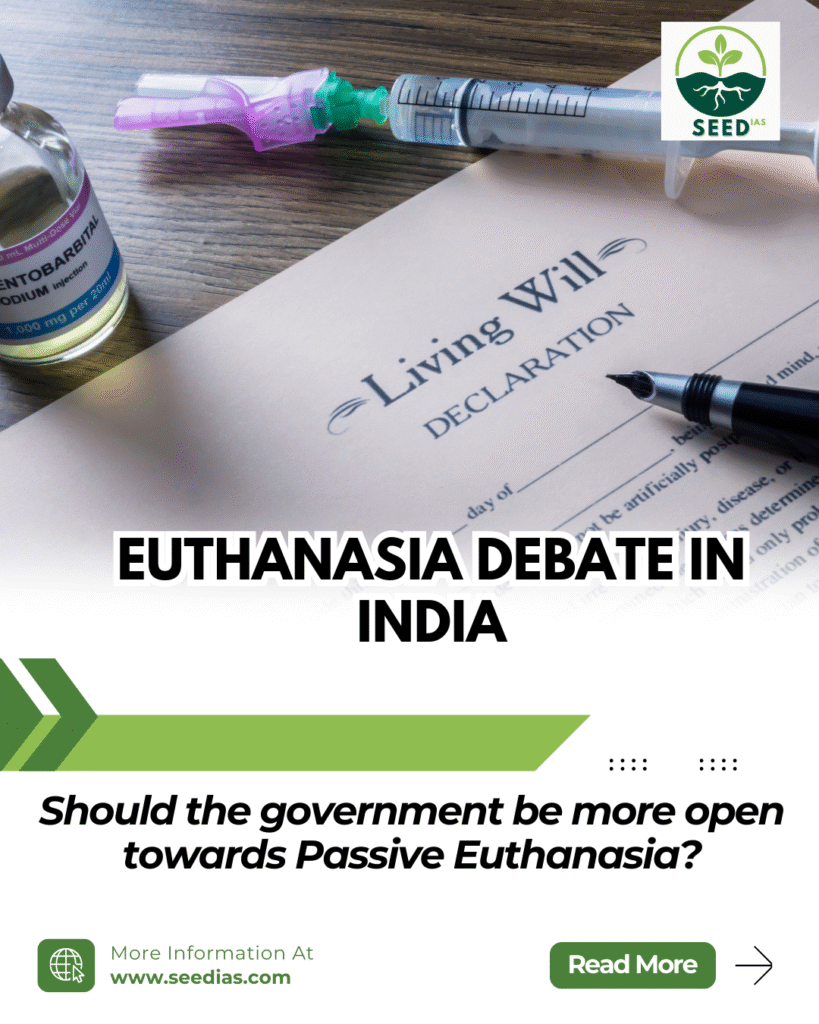
The Supreme Court is hearing Harish Rana vs Union of India (2025), a plea seeking passive euthanasia through withdrawal of life-sustaining treatment.
The petitioner has 100% quadriplegic disability and has been bedridden for 13+ years after a severe fall.
Summary
The Supreme Court has reserved its judgment in this landmark plea.
Active euthanasia remains illegal, but passive euthanasia is legally allowed under strict SC-mandated safeguards as part of the Right to Die with Dignity (Article 21).
The case revives debate between individual autonomy and protection of vulnerable groups.
What is Euthanasia?
Intentional hastening of death to relieve suffering from incurable or terminal illness.
Types:
• Active: direct act (e.g., lethal injection) — illegal in India
• Passive: withdrawing or withholding treatment — permitted with safeguards
Sub-types:
• Voluntary (consented)
• Non-voluntary (incompetent patient)
• Involuntary (against wishes — illegal)
Legal Framework in India
• Active euthanasia prohibited under BNS 2023:
o Sec 100 — culpable homicide
o Sec 101 — murder
o Sec 108 — abetment of suicide
• Passive euthanasia recognized by SC as part of Article 21.
• Law Commission Report (241st, 2012): refusal of life support by a competent patient is legally valid; doctors not criminally liable.
Landmark Judgments
1987 – Maruti Shripati Dubal
Right to die included in Article 21 — later overturned.
1996 – Gian Kaur vs State of Punjab
Right to life ≠ right to die; euthanasia disallowed.
2011 – Aruna Shanbaug
Passive euthanasia allowed for non-consenting patients under strict safeguards.
2018 – Common Cause vs Union of India
• Passive euthanasia legalized.
• Living Wills (Advanced Medical Directives) recognised.
• “Right to Die with Dignity” upheld as part of Article 21.
Procedure for Passive Euthanasia (Post-2018, Updated 2023)
Medical Boards (Two-tier system):
Primary Medical Board (Hospital)
• 3 specialists (experience 5+ years).
• Head of treating department included.
Secondary Medical Board (District Level)
• Constituted by the District Medical Officer (DMO nominee).
• 3 experts.
• Opinion required within 48 hours.
2023 simplification:
• Experience requirement reduced (20 → 5 years).
• Strict timelines.
• Streamlined composition for ease of implementation.
Global Legal Landscape
• Euthanasia + PAS permitted: Netherlands, Belgium, Luxembourg, Spain, Canada (Quebec), parts of Australia.
• Assisted suicide only: Switzerland.
• Passive euthanasia allowed: France, Sweden, Italy (treatment refusal).
Ethical and Practical Controversies
Arguments For
• Autonomy & dignity: supported in Common Cause (2018).
• Relief from incurable suffering.
• Prevents futile intervention and emotional/financial strain.
• Supported by libertarian (J.S. Mill) and utilitarian ethics (Bentham).
Arguments Against
• Sanctity of life: religious & deontological (Kant).
• High misuse risk for elderly, disabled, or poor.
• Difficulty assessing true consent (depression/coercion).
• Stringent criminal provisions under BNS create fear among practitioners.
• Cumbersome procedures limit accessibility.
Strengthening India’s End-of-Life Framework
- Legislative Clarity
Enact a dedicated law incorporating SC guidelines on passive euthanasia & living wills. - Procedural Reform
Use district-level or hospital ethics committees; integrate living wills in National Digital Health Records (NDHR). - Universal Palliative Care
Expand hospice & home-based care via Ayushman Bharat; train ASHA workers. - Safeguards Against Misuse
Mandatory psychiatric evaluation; social audits; cooling-off periods. - Public Awareness
National campaigns on living wills, end-of-life rights, cultural dialogues involving medical, legal, ethical, and religious bodies. Conclusion
The Harish Rana case highlights the pressing need for coherent legislation and accessible processes for passive euthanasia.
While the principles of dignity and autonomy strengthen the case for permitting end-of-life choices, India must balance these with robust safeguards, universal palliative care, and procedural clarity to protect vulnerable populations and uphold ethical medical practice.
UPSC Civil Services Examination, Previous Year Questions (PYQs)
Prelims
Q. Right to Privacy is protected as an intrinsic part of Right to Life and Personal Liberty. Which of the following in the Constitution of India correctly and appropriately imply the above statement? (2018)
(a) Article 14 and the provisions under the 42nd Amendment to the Constitution.
(b) Article 17 and the Directive Principles of State Policy in Part IV.
(c) Article 21 and the freedoms guaranteed in Part III.
(d) Article 24 and the provisions under the 44th Amendment to the Constitution.
Ans: (c)