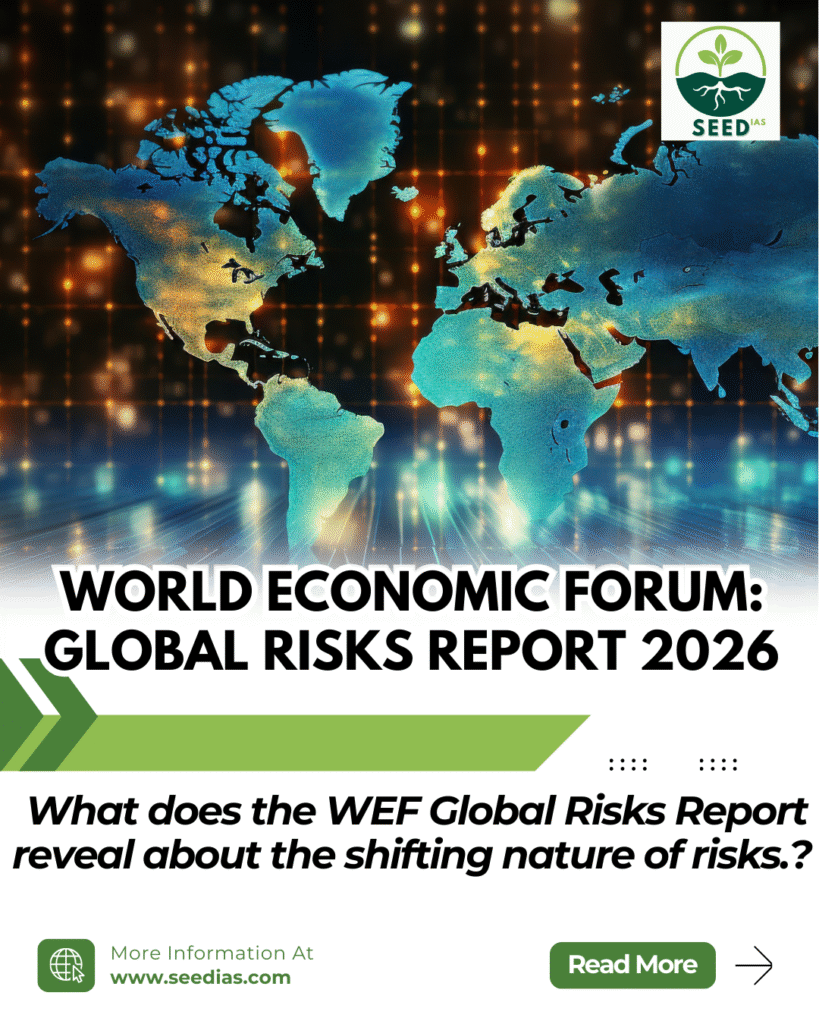
Key Findings of the Global Risks Report 2026 –
Global Risk Outlook
Immediate term (2026):
• Geoeconomic Confrontation is the most likely global crisis trigger—driven by sanctions, trade controls, tech restrictions, and investment barriers—reflecting weakening multilateralism and rising protectionism.
• State-based armed conflicts rank second due to ongoing wars and regional instability.
• Extreme weather events and societal polarisation remain high-risk.
• Misinformation & disinformation is now the 5th biggest global threat.
• AI risks (misuse, job loss, ethical concerns) enter the top 10 for the first time.
• Cyber insecurity ranks 9th globally as digital dependency increases.
Long term (10-year horizon):
• Climate-linked threats—extreme weather, biodiversity loss, and Earth-system changes—dominate the top global risks.
India Risk Outlook (2026)
The report highlights a domestic risk landscape shaped by digital, social, and governance vulnerabilities, with comparatively less geopolitical dominance than global trends.
- Cybersecurity – India’s No. 1 Risk
Driven by rapid digitalisation across governance, finance, identity systems, and critical infrastructure. - Income & Wealth Inequality
Emerging as a major macro-risk despite low Gini values, due to widening wealth concentration and structural labour-market disparities. - Insufficient Public Services & Social Protection
Low spending on health (1.9% of GDP) and social protection (~5% of GDP) magnifies the impact of economic or climate shocks. - Economic Downturn Vulnerability
FPI outflows, export dependence, and global volatility heighten recession risks. - State-Based Armed Conflict & Hybrid Threats
Terror incidents, cross-border militancy, and cyber–information warfare increase strategic instability.
Major Risks Facing India in the Emerging Global Landscape
- Cybersecurity as a Systemic National Vulnerability
• 369 million malware detections in 2025.
• Dominance of Trojans and mobile threats.
• Digital concentration (UPI, Aadhaar, DBT) raises single-point failure risks. - Inequality as a Risk Multiplier
• Top 1% earning 22.6% of national income (Oxfam).
• Amplifies social unrest, polarisation, and governance challenges. - Weak Public Services & Social Protection
• Low investment in health, education, urban systems, and pensions undermines crisis absorption capacity. - Geoeconomic Shocks
• Highly integrated economy vulnerable to global trade wars, tariffs, capital outflows, and energy price swings. - Armed Conflict & Hybrid Threats
• Persistent terrorism, insurgencies, cyber warfare, and disinformation campaigns stress security systems.
What India Should Do – Priority Actions
- Strengthen Economic Resilience
• Deepen domestic manufacturing.
• Diversify trade via FTAs.
• Maintain forex buffers and counter-cyclical fiscal space. - Treat Inequality as a Macro-Risk
• Boost formalisation, social protection, health coverage.
• Strengthen income security for informal workers. - Build Capacity Against Hybrid Threats
• Establish unified intelligence fusion.
• Enhance cyber and financial surveillance.
• Adopt a comprehensive National Security Strategy. - Protect Information Integrity
• Expand fact-checking, digital literacy (PM-DISHA).
• Use IT Rules 2021 and ECI’s FACT principle.
• Address disinformation as a national security threat. - Embed Climate Resilience in Development
• Strengthen climate adaptation via NAPCC, Mission LiFE, NDMP.
• Invest in climate-resilient infrastructure (Gati Shakti, Smart Cities).
Conclusion
The Global Risks Report 2026 shows that India’s vulnerability stems from the intersection of cyber insecurity, widening inequality, geoeconomic volatility, and hybrid security threats.
Without stronger resilience, governance capacity, social protection, and digital security, external shocks can rapidly escalate into domestic instability.
PRACTICE QUESTIONS
1. Which of the following is identified as the most severe global risk for 2026 in the World Economic Forum’s Global Risks Report 2026?
A. State-based armed conflict
B. Extreme weather events
C. Geoeconomic confrontation
D. Cyber insecurity
Answer: C
2. According to the Global Risks Report 2026, which one of the following is listed as the top risk for India in the immediate term (2026)?
A. Income and wealth inequality
B. Cybersecurity vulnerability
C. Geoeconomic shocks
D. State-based armed conflict
Answer: B
3. Consider the following statements regarding India’s emerging risk landscape:
- India spends around 13% of GDP on social protection, which is at par with the global average.
- The top 1% of India’s population accounts for over 22% of national income, reflecting widening inequality.
- Cyber threats in India are increasingly becoming systemic risks, capable of disrupting elections and financial systems.
4.Which of the statements given above is/are correct?
A. 1 and 2 only
B. 2 and 3 only
C. 1 and 3 only
D. 1, 2 and 3
Answer: B