CONTEXT OF THE NEWS
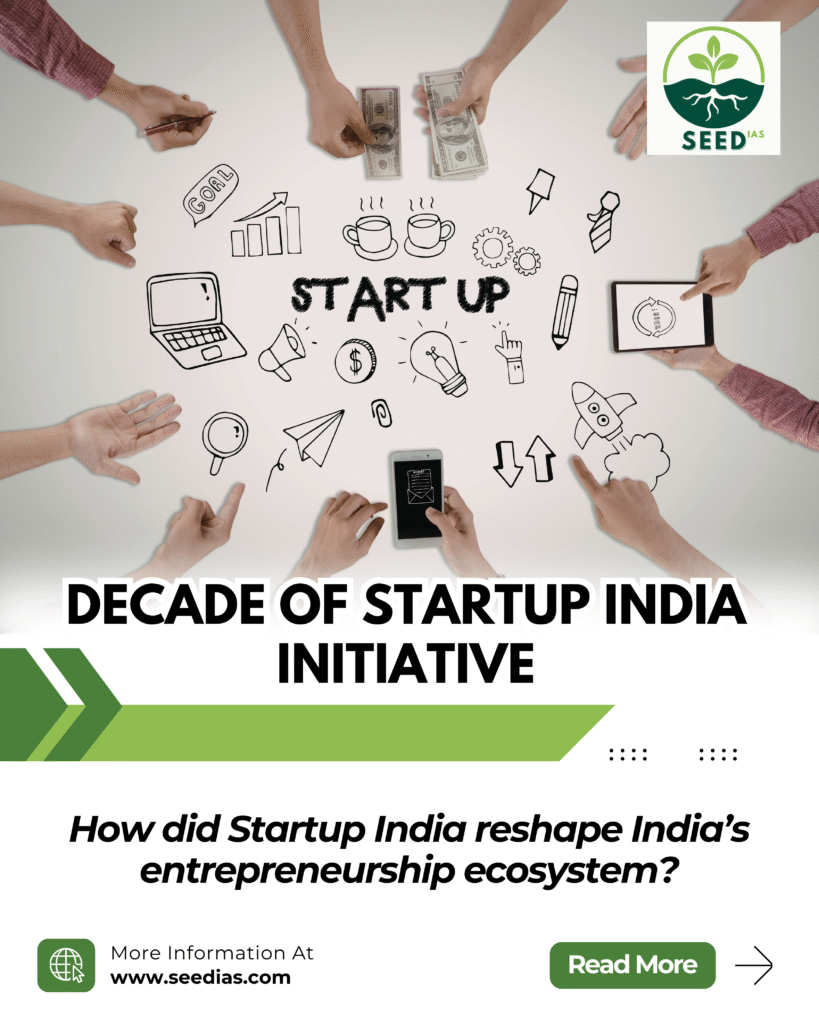
On National Startup Day (16 January 2026), the Prime Minister highlighted 10 years of the Startup India Initiative at Bharat Mandapam, New Delhi.
The occasion marked India’s journey from a policy-driven push in 2016 to becoming one of the world’s largest startup ecosystems, aligned with Viksit Bharat 2047.
BACKGROUND
The Startup India Initiative was launched in 2016 to promote entrepreneurship and innovation.
This topic is relevant for GS Paper III (Economic Development, Entrepreneurship) and Prelims (Government Schemes, Startups, Innovation).
NEWS BREAKDOWN
WHAT IS THE STARTUP INDIA INITIATIVE?
A government programme launched on 16 January 2016 to support startups and encourage job creators instead of job seekers.
What is Startup?
A startup is a young enterprise that introduces new or improved products/services, disrupts markets, or creates new ones.
Implementation
- Implemented by Department for Promotion of Industry and Internal Trade (DPIIT)
- Dedicated Startup India Team
KEY OBJECTIVES
- Nurture Innovation
→ Support innovative ideas and scalable solutions - Promote Entrepreneurship
→ Reduce regulatory burden and ease compliance - Enable Investment
→ Improve access to funding and capital - Economic Growth & Jobs
→ Generate large-scale employment
MAJOR SCHEMES AND SUPPORT PILLARS
Fund of Funds for Startups (FFS)
- Corpus: ₹10,000 crore
- Managed by Small Industries Development Bank of India (SIDBI)
- Invests in SEBI-registered AIFs, not directly in startups
- Expands domestic risk capital
Startup India Seed Fund Scheme (SISFS)
- Corpus: ₹945 crore
- Supports:
- Proof of Concept
- Prototyping
- Market entry
Credit Guarantee Scheme for Startups (CGSS)
- Enables collateral-free loans
- Implemented through NCGTC
Startup India Hub
- Single-window digital platform
- Connects startups with:
- Investors
- Mentors
- Incubators
- Government bodies
States’ Startup Ranking Framework (SRF)
- Ranks States/UTs as:
- Best Performers
- Top Performers
- Leaders
- Emerging Ecosystems
- Promotes competitive federalism
Mentorship & Networking
- MAARG Portal
- Startup India Investor Connect Portal
IMPACT AND ACHIEVEMENTS (AS OF DECEMBER 2025)
- 2 lakh+ DPIIT-recognised startups
- 44,000 startups registered in 2025 alone
- 50% startups from Tier II & Tier III cities
- Unicorn growth:
- 4 unicorns in 2014
- 120+ unicorns now
- Combined valuation: USD 350+ billion
OTHER SCHEMES STRENGTHENING STARTUPS
- Atal Innovation Mission (AIM) – NITI Aayog
- Atal Tinkering Labs
- AIM 2.0, Deeptech Reactor, ASIL
- GENESIS Scheme – MeitY
- Focus on deep-tech and Tier II & III cities
- TIDE 2.0 – MeitY
- Supports AI, IoT, Blockchain, Robotics, Health-tech
- NIDHI Programme – DST
- Idea-to-startup support
- SVEP – DAY-NRLM
- Rural entrepreneurship
- ASPIRE Scheme – MSME Ministry
- Innovation in rural areas
- PMEGP – KVIC
- Margin money subsidy:
- 25% rural, 15% urban (General)
- 35% rural, 25% urban (Special Categories)
- Margin money subsidy:
KEY CHALLENGES FACED BY STARTUPS
- Low R&D Intensity
- Only 0.64% of GDP
- Funding Slowdown
- Seed funding down by 25% (2024)
- D2C funding down by 18%
- 5000+ startup closures
- Limited domestic venture capital
- Deep-tech underdevelopment
- Infrastructure gaps beyond metros
- Weak exit options (IPO & acquisitions)
STEPS NEEDED TO STRENGTHEN ECOSYSTEM
- Enable pension and insurance funds to invest in startups
- Boost industry–academia collaboration
- Increase applied R&D funding
- Support deep-tech scale-up
- Improve Tier II & III infrastructure
- Simplify tax, IPR, and exit regulations
- Promote green and sustainable startups
PRELIMS FOCUS
- Startup India launched: 16 January 2016
- Implementing ministry: DPIIT
- FFS corpus: ₹10,000 crore
- India’s R&D expenditure: ~0.64% of GDP
- Unicorn definition: Valuation USD 1 billion+
CONCLUSION / WAY FORWARD
Startup India must now shift from expansion to innovation-led, sustainable scaling to drive deep-tech growth, quality jobs, and long-term economic resilience.
PRELIMS CHECK
Q1. With reference to the Fund of Funds for Startups (FFS), consider the following statements:
- It directly invests in startups.
- It is managed by SIDBI.
- It supports SEBI-registered Alternative Investment Funds.
Which of the statements given above are correct?
(a) 2 and 3 only
(b) 1 and 3 only
(c) 1 and 2 only
(d) 1, 2 and 3
Q2. Consider the following pairs:
| Scheme | Implementing Ministry |
| GENESIS | MeitY |
| NIDHI | Department of Science and Technology |
| SVEP | Ministry of Commerce and Industry |
Which of the pairs given above are correctly matched?
(a) Only one
(b) Only two
(c) All three
(d) None
Q3. Consider the following statements:
- Nearly half of India’s startups originate from Tier II and Tier III cities.
- India’s R&D expenditure is above the global average.
Which of the statements given above is/are correct?
(a) 1 only
(b) 2 only
(c) Both 1 and 2
(d) Neither 1 nor 2
ANSWERS WITH EXPLANATION
Q1 – (a)
- FFS does not invest directly in startups
- Managed by SIDBI
- Invests through SEBI-registered AIFs
Q2 – (b)
- GENESIS → MeitY ✔
- NIDHI → DST ✔
- SVEP → Implemented under DAY-NRLM, not Commerce ✘
Q3 – (a)
- Around 50% startups from Tier II & III ✔
- India’s R&D intensity is below global average ✘
“Great nations are built when ideas are given the freedom to grow.”