Why in News?
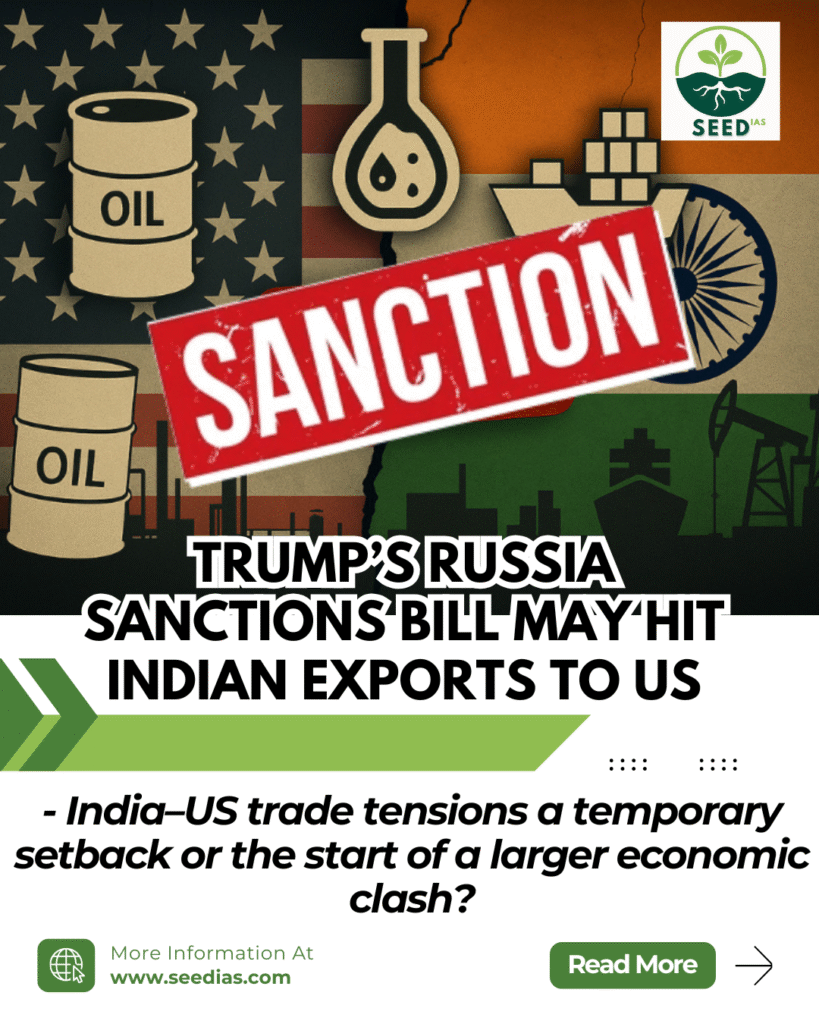
US Republican Senator Lindsey Graham announced that President Donald Trump has approved a proposed Russia Sanctions Bill that seeks to impose 500% tariffs on all goods and services imported from countries that continue buying Russian-origin oil, gas, uranium, and petroleum products.
Why is the US sanctioning Russian oil?
Reasons
- To weaken Russia’s revenue sources (oil & gas generate ~40% of Russian budget revenue).
- To deter Russia’s continuation of the Ukraine war.
- To uphold US/Western strategic dominance and prevent Russia from bypassing sanctions via Asian markets.
- Energy geopolitics—reshaping global supply chains to reduce Russian influence.
- Domestic politics in the US—projecting toughness on Russia.
Status of India’s Oil Imports from Russia
- Before 2022: Russia supplied <2% of India’s crude.
- After sanctions & G7 price cap: Russia became India’s largest crude oil supplier (>30% share).
- India buys discounted Russian crude, refining it into products that sometimes reach Western markets.
- India argues: imports are based on national interest and energy security.
What are unilateral and secondary sanctions?
Unilateral Sanctions
Imposed by one country (e.g., the US) without UN approval.
Apply to that country’s own citizens, companies, banks, and territory.
Secondary Sanctions
Target third countries that trade with the sanctioned country.
Aim to coerce foreign firms by threatening to cut their access to the US market or financial system.
Highly controversial under international law.
This proposed Bill = a secondary sanction regime.
How may the US-Russia Sanctions Bill impact India?
Severe Impact Areas
- Exports to the US will collapse
o A 500% tariff makes goods uncompetitive.
o Affects textiles, leather, footwear, marine products, gems & jewellery. - Supply chain disruption
o India not as export-diversified as China → more vulnerable. - India–US trade deal will be jeopardised
o India is in negotiations; steep tariffs weaken India’s bargaining position. - Geopolitical dilemma
o India must balance between:
Strategic partnership with the US, and
Energy partnership with Russia. - Pressure to reduce Russian oil purchases
o But this affects India’s energy security and import bill. - Risk of retaliatory tariffs
o India might also impose tariffs → escalation of trade tension. - Significance of Export Diversification
• Reduces dependence on any single market (e.g., overdependence on the US).
• Protects exporters from policy shocks (tariffs, sanctions, recessions).
• Essential for stable growth and for reducing vulnerability to geopolitical risks.
• China survived US tariffs due to diversified global markets and dominance in electronics & critical minerals.
India lacks similar diversification—making it more exposed.
Way Forward
Short-Term
- Diplomatic engagement with US
o Seek exemption or relaxation.
o Explain India’s energy needs and G7 price-cap compliance. - Increase sourcing transparency
o Demonstrate non-military use of Russian imports.
o Provide certifications for refined products. - Expand alternative markets
o Boost trade with EU, ASEAN, GCC, Africa, and Latin America.
Medium-Term - Accelerate trade agreements
o EU FTA, ASEAN upgrade, EAEU, GCC.
o Reduce dependence on the US. - Move up the value chain
o Encourage sunrise sectors: electronics, semiconductors, EVs, pharma formulations.
Long-Term - Improve competitiveness
o Reduce logistics costs, improve infrastructure, and scale up manufacturing.
o Promote R&D-intensive sectors.
Practice questions
Question 1
With reference to secondary sanctions, consider the following statements:
- They apply only to the citizens and companies of the country imposing the sanctions.
- They penalise third countries that engage in trade with a sanctioned nation.
- They are authorised under the WTO dispute settlement mechanism.
Which of the statements given above is/are correct?
(a) 1 only
(b) 2 only
(c) 1 and 3 only
(d) 2 and 3 only
Question 2
Consider the following statements regarding India’s oil imports from Russia:
- Russia has become one of India’s largest suppliers of crude oil after the Russia–Ukraine war.
- India purchases Russian oil primarily because it is available at a discounted price.
- India’s oil imports from Russia violate the G7 price-cap policy.
Which of the statements given above is/are correct?
(a) 1 and 2 only
(b) 2 and 3 only
(c) 1 and 3 only
(d) 1, 2 and 3
Question 3
The proposed US “Russia Sanctions Bill” is significant for India because:
- It proposes a 500% tariff on goods imported from countries that continue buying Russian-origin oil and uranium.
- India’s exports to the US are highly diversified across multiple high-technology sectors, reducing tariff-related risks.
- India and the US currently have a comprehensive Free Trade Agreement that shields Indian exports from unilateral US tariffs.
Which of the statements given above is/are correct?
(a) 1 only
(b) 1 and 2 only
(c) 2 and 3 only
(d) 1, 2 and 3