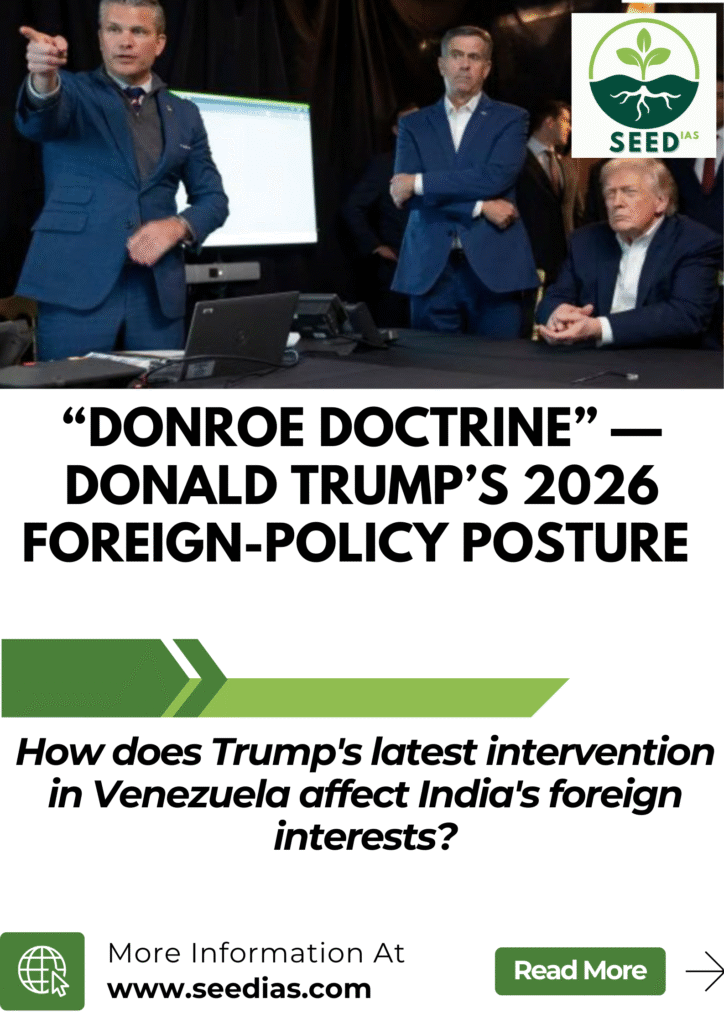
Why in News?
The U.S. capture of Venezuelan President Nicolás Maduro and Washington’s announcement that it will take control of Venezuela’s oil sector have sparked global debate. Analysts argue these actions reflect a new “Donroe Doctrine,” signalling an assertive U.S. claim to guardianship in the Western Hemisphere. This shift carries major implications for sovereignty, geopolitics, and countries like India that depend on stable global oil markets.
Key Features of the “Donroe Doctrine”
- Sphere of Influence Reasserted
The Western Hemisphere is treated as a privileged US security zone. External actors are framed as intruders, and Latin America becomes “our neighbourhood.” - Securitisation of Regional Issues
Problems such as migration, narcotics, and energy volatility are reframed as US national security threats. This blurs lines between another country’s domestic affairs and US internal security, widening the justification for intervention. - Shift in Normative Goals
Democracy promotion recedes; control, stability, and predictability dominate. The doctrine reflects a US strategic focus on great-power competition, resource control, and managing nearby instability.
Implications
• Normalisation of Spheres of Influence threatens sovereign equality globally.
• Legitimacy Challenges arise due to Latin America’s long history of intervention.
• Precedent for Other Powers to claim similar rights in their neighbourhoods.
Venezuela Context
The doctrine becomes concrete in US oversight of Venezuela following the capture of President Maduro. Washington plans to revitalise Venezuela’s oil sector with US companies. Although Venezuela has the world’s largest oil reserves, serious investment and years of rebuilding would be required to increase production.
Implications for India - Principle & Precedent
India values sovereignty and non-intervention; accepting externally supervised political transitions could undermine long-term interests. - Partnership with the US
India’s close ties with the US are important, but America’s abrupt shifts in foreign-policy tone necessitate strategic autonomy. - Identity & Role
India must balance its status as a rising Asian power and spokesperson for the Global South — defending sovereign equality while avoiding moralistic grandstanding.
India’s current restrained, measured posture toward US actions in Venezuela preserves room for cooperation with Washington while not endorsing foreign guardianship. But restraint should be paired with quiet diplomacy, regional mediation support, humanitarian relief, and reaffirming global norms.
Energy Angle for India
Over the medium to long term, a revived Venezuelan oil sector might supply discounted crude useful for India’s complex refineries, though meaningful change is not expected soon.