Why in News?
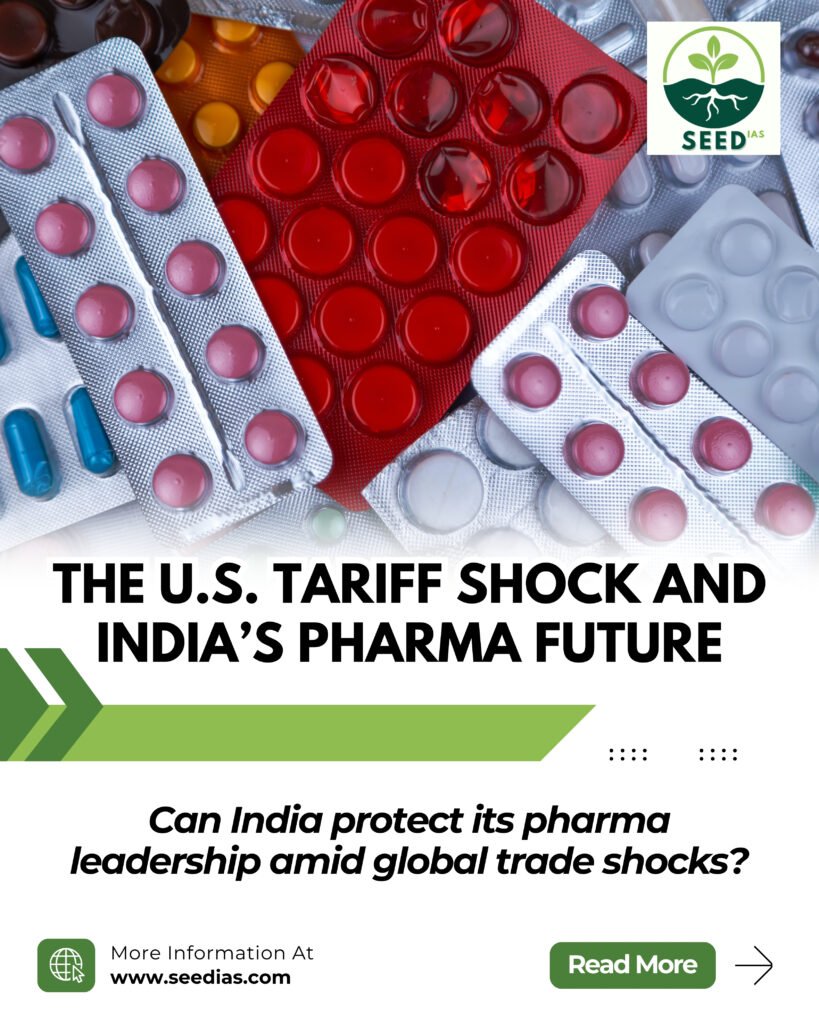
In September 2025, Donald Trump announced a 100% tariff on branded and patented pharmaceutical imports into the U.S.
The decision has raised concerns for India’s pharmaceutical sector, which is deeply integrated with U.S. health-care supply chains.
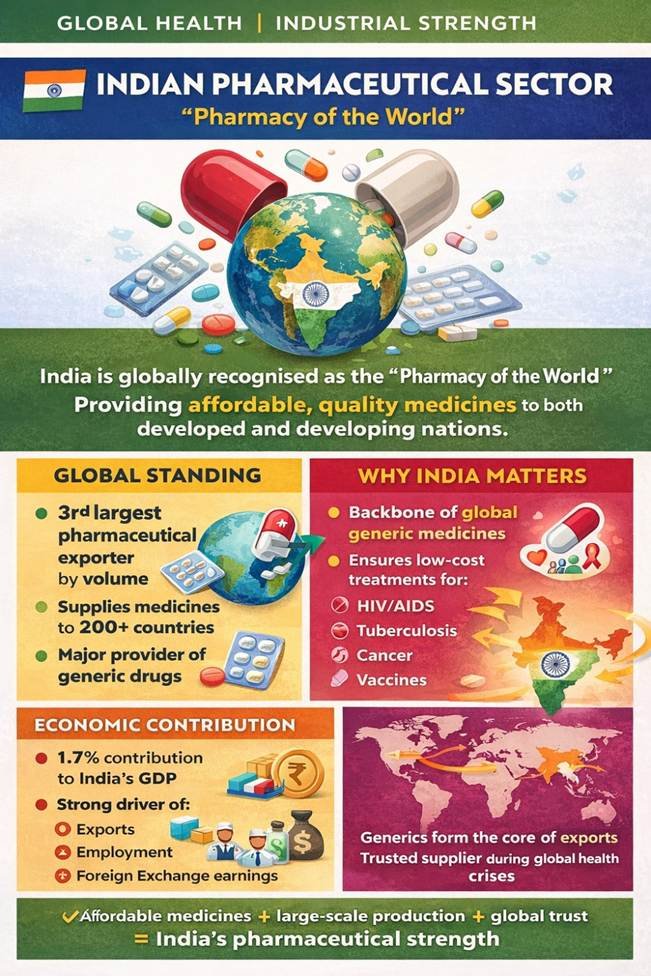
Importance of the U.S. Market for India
The U.S. is India’s largest pharmaceutical export destination.
India supplies about 40% of generic medicines used in the U.S.
Indian generics save the U.S. health-care system billions of dollars annually.
The new U.S. tariff currently exempts generics.
Branded and patented drugs are the main targets.
Impact of the U.S. Tariff Decision
The announcement caused immediate market uncertainty.
Pharma company shares declined due to fear of escalation.
If tariffs extend to generics in future:
- Export revenues may fall
- GDP growth could be affected
- Firms with high U.S. dependence may face stress
Other risks include:
- Higher API costs
- Regulatory delays
- Pressure on research and development
Global Pharmaceutical Trade Context
Global pharmaceutical trade is expanding rapidly.
Aging populations and chronic diseases drive demand.
Post-pandemic innovation has accelerated growth.
Western countries focus on innovation and patents.
Eastern economies focus on scale and cost efficiency.
The European Union remains a major exporter.
China is expanding influence through biotech deals and licensing.
India’s Structural Strength: Dominance in Generics
Generics form nearly 70% of India’s exports to developed markets.
They are 80% cheaper than branded medicines.
They enable millions of treatments every year.
This dominance cushions India from immediate tariff shocks.
However, quality perception and supply disruptions remain concerns.
Supply Chain Vulnerabilities
India depends heavily on imported Active Pharmaceutical Ingredients (APIs).
A large share comes from China.
This creates strategic and cost vulnerabilities.
Any disruption raises input prices.
It affects margins and medicine availability
Domestic Policy Support and GST Rationalisation
India reduced GST on medicines and medical devices in September 2025.
Essential medicines now attract lower or zero tax.
This:
- Lowers consumer costs
- Boosts domestic demand
- Supports health access
It aligns with public health programmes and social welfare goals.
Role of Public Health Schemes
The Pradhan Mantri Bhartiya Janaushadhi Pariyojana strengthens domestic resilience.
Key features:
- Wide network of Jan Aushadhi Kendras
- Affordable generic medicines
- Reduced out-of-pocket health expenditure
The scheme proves that domestic buffers can protect citizens.
India’s Diversification Strategy
India is expanding partnerships beyond the West.
Focus areas include:
- Africa
- Southeast Asia
- Caribbean nations
Recent MoUs and API collaborations support this shift.
Trade fairs like iPHEX promote Indian pharma globally.
Eastern alliances can offset tariff risks.
They also reduce over-dependence on one market.
Future Outlook of India’s Pharma Sector
India’s pharma industry has strong growth potential.
Exports and domestic markets are expected to expand steadily.
Growth drivers include:
- Biosimilars
- Precision medicine
- API self-reliance
- Production-Linked Incentive (PLI) schemes
With reforms, India can move up the value chain.
Key Challenges Ahead
- Intellectual property disputes
- API dependence
- Regulatory compliance costs
- Quality perception issues
Global trade uncertainty adds pressure.
Strategic policy support remains essential.
What Should India Do?
India must:
- Diversify export destinations
- Strengthen API manufacturing
- Invest in research and innovation
- Use multilateral platforms like the World Trade Organization to raise concerns
- Balance affordability with innovation
East-West collaboration, not confrontation, is crucial.