Context of the News
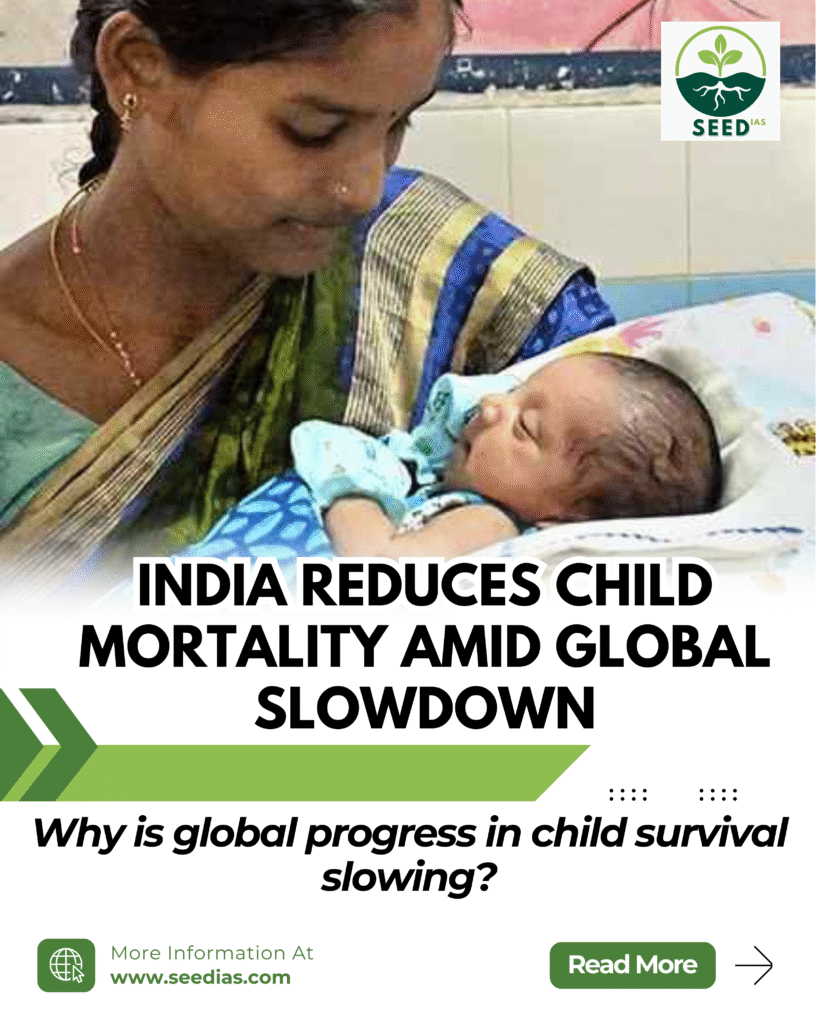
A recent United Nations Inter-Agency Group for Child Mortality Estimation (UNIGME) Report, 2025 highlights that India is steadily reducing child deaths, even as global progress slows significantly.
News Breakdown
Key Definitions
- Neonatal Mortality Rate (NMR): Number of deaths within 28 days of birth per 1,000 live births
- Under-5 Mortality Rate (U5MR): Number of deaths of children under 5 years per 1,000 live births
Global Scenario
- 4.9 million children died before age 5 in 2024
- Includes 2.3 million newborns
- Under-5 deaths have fallen by more than half since 2000
- However, progress has slowed by over 60% since 2015
Causes of Child Deaths:
- Newborn stage:
- Preterm birth complications (36%)
- Labour/delivery complications (21%)
- After first month:
- Malaria (17%)
- Diarrhoea
- Pneumonia
India’s Performance
India has shown consistent and significant improvement:
| Indicator | 1990 | 2024 |
| Neonatal Mortality Rate (NMR) | 57 | 17 |
| Under-5 Mortality Rate (U5MR) | 127 | 27 |
Key Achievements:
- Sharp decline in child mortality rates
- Major contributor to South Asia’s progress
Reasons for India’s Success
- Expanded immunisation coverage
- Increased institutional deliveries
- Strengthening of public health systems
- Targeted schemes like:
- Maternal and Child Health programs
- Nutrition initiatives
Emerging Concerns Globally
Severe Acute Malnutrition (SAM)
- Over 1 lakh deaths (age 1–59 months) in 2024
- Accounts for 5% of child deaths
- Often underreported as a cause
Impact:
- Weakens immunity
- Increases vulnerability to common infections
Other Key Trends
- 2.1 million deaths in age group 5–24 years
- Leading causes:
- Self-harm (girls 15–19)
- Road accidents (boys)
- Sub-Saharan Africa:
- Accounts for 58% of global under-5 deaths
Comparative Snapshot
| Region | Share in Under-5 Deaths |
| Sub-Saharan Africa | 58% |
| South Asia (incl. India) | Significant but declining |
| Global trend | Slowing progress |
Prelims Focus
- SDG Target 3.2:
- End preventable deaths of children under 5
- Reduce NMR to ≤12 per 1,000
- Reduce U5MR to ≤25 per 1,000
- Malaria remains leading infectious killer of children globally
- Severe Acute Malnutrition (SAM):
- Defined by very low weight-for-height
- Medical emergency in children
Conclusion / Way Forward
India must sustain gains by strengthening nutrition, primary healthcare, and maternal services, while addressing emerging risks like malnutrition and adolescent health challenges.
Prelims Check
Question 1
Consider the following statements:
- Neonatal Mortality Rate refers to deaths within the first year of life.
- Under-5 Mortality Rate includes neonatal deaths.
- SDG targets aim to reduce U5MR below 25 per 1,000 live births.
Which of the statements given above is/are correct?
(a) 2 and 3 only
(b) 1 and 2 only
(c) 1 and 3 only
(d) 2 only
Question 2
With reference to Severe Acute Malnutrition (SAM), consider the following statements:
- It weakens immunity in children.
- It is always recorded as the primary cause of death.
- It increases susceptibility to infections.
Which of the statements given above is/are correct?
(a) 1 and 3 only
(b) 2 only
(c) 1, 2 and 3
(d) 1 only
Question 3
Consider the following statements:
Statement-I: Global reduction in child mortality has slowed after 2015.
Statement-II: Most child deaths today are preventable with low-cost interventions.
Which one of the following is correct?
(a) Both Statement-I and Statement-II are correct and Statement-II explains Statement-I
(b) Both Statement-I and Statement-II are correct but Statement-II does not explain Statement-I
(c) Statement-I is correct, but Statement-II is incorrect
(d) Statement-I is incorrect, but Statement-II is correct
Answers with Explanation
Q1: (a) 2 and 3 only
- Neonatal = first 28 days → Statement 1 incorrect
- U5MR includes neonatal deaths → Correct
- SDG target = ≤25 → Correct
Q2: (a) 1 and 3 only
- Weakens immunity → Correct
- Often underreported → Statement 2 incorrect
- Increases infection risk → Correct
Q3: (b) Both correct but not explanation
- Slowdown after 2015 → True
- Deaths preventable → True
- But does not explain slowdown directly
“Progress in public health is not accidental—it is the result of sustained commitment and collective action.”